It's almost Christmas, but I haven't been posting in so long that I have a huge backlog of stories to share. Since "why not?", I thought I would post some shots and memories from our summer trip to the Dutch island of Texel.
News of the heat wave hitting Italy this summer really made me appreciate the mild temperatures we enjoy during the Dutch summer. True, summer in the Netherlands starts late (as in "we've been freezing our butts off until the end of July") and ends early (as in "three weeks later"), but when it's here we enjoy the most ideal conditions you can wish for: 25°C during the hottest hours of the day, 16° at night, a mild sun with a light breeze. Perfection!
It is the ideal weather to cycle, enjoy an open-air lunch or a glass of wine after work, and spend the weekend exploring this green, luscious country.
That's exactly what we did in August, when we spent a weekend on the island of Texel, one of the 5 Dutch Frisian Islands of the Wadden sea. Having never heard of the "Waddenzee" before moving to the Netherlands (I did not even know that the Netherlands have islands to be honest) I feel it is necessary to say that it is a stretch of water in the south-eastern part of the North Sea, that spans from the north-eastern part of the Dutch coastline, across the whole northern borders of Germany, to the south-western part of Denmark. It is an intertidal zone, or - in simple words - an area that is above water at low tide and under water at high tide. Yes, you've read well! When the tide is low, the water can become really shallow, so much that I've been told that in specific times and seasons you can actually WALK from Den Helder on the Dutch mainland to the southern tip of the Texel island. There is even a word for this activity: Wadlopen or "mudflat hiking".
Texel was the first Wadden Island I visited and it is so beautiful that now I wish to visit them all. Thanks to ever changing tides, the landscape is rich in biological diversity - a true paradise for birds and other animals, including seals. So much that the Wadden Sea has been inscribed on UNESCO's World Heritage List, and about one third of Texel is a protected nature reserve!
Texel, oddly enough, is just 2 metres above sea level, but this is not so surprising as it's part of the Netherlands. The island measures 25 km in lenght and 10 km in width, and all its beaches are on the north side, a long 30 km stretch of flat sands.
But apart from geography, I'd say pictures speak for themselves. This island is an absolute paradise for nature lovers. And, of course, bike lovers: it's almost flat so it's easy to reach any destination with minimum effort, and the scenery is worth the exercise.


The first day we did the northern perimeter. From Den Koog we cycled the 15 km to the Lighthouse on the northernmost tip of the island, stopping along the way for a walk on De Slufter, a dune valley into which seawater streams through creeks during high tide, allowing for vegetation to grow and creating a rich environment where birds love to nest. During the summer the area is suggestively purple-colored because of the sea lavender growing everywhere. Charming!


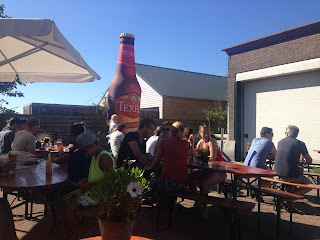
From the lighthouse, we continued southward along the east coast, until reaching the small town of Oudeschild, where the Texels Brewery is located. This artesanal brewery is renowned in the whole of the Netherlands for its great beers, and here you can taste it straight out of their barrels, enjoying the sun and local cheese in their patio. From Oudeschild we crossed the island back to Den Koog, crossing green fields with happy cows and sheeps grazing. The whole trip, 50 km, wasn't tiring at all (ok maybe we felt our legs a little after the stop at the brewery), and took us less than 8 hours to complete, including two long stops at De Slufter and the brewery, a picnic at the lighthouse, and various short stops for pictures.



The second day we cycled south to reach the vast beaches facing Den Helder. The low tide in the morning (when you can actually walk your way across the canal) means that the beach is so huge that you have to walk for 15 minutes before reaching the sea. We chilled in the sun for a couple of hours and then cycled back to Den Koog, just in time for another delicious Texels beer and to catch the 17:18 bus to Den Helder.


Fun fact: the same bus will actually take you in and out of the island as it actually boards the ferry connecting it to the mainland. Don't make the mistake we did on Friday evening and get off the bus when you board the ferry: the crossing only takes 20 minutes and if you are not back before reaching the dryland, you will be left on foot in the middle of nowhere, as the bus is super quick to desembark and retrieve its route. This happened to us and we would have had to wait for 1 whole hour before the next ferry (and bus) arrived. Luckily, we hitch-hicked our way to the camping thanks to some very nice islanders. People are very friendly on Texel: maybe it's because their main source of income is tourism...or maybe because for the most part of the year the island is cold, grey, and nobody comes to visit...or maybe they are just happy to live in such a special place. Anyway, we only had positive experiences with local people!
News of the heat wave hitting Italy this summer really made me appreciate the mild temperatures we enjoy during the Dutch summer. True, summer in the Netherlands starts late (as in "we've been freezing our butts off until the end of July") and ends early (as in "three weeks later"), but when it's here we enjoy the most ideal conditions you can wish for: 25°C during the hottest hours of the day, 16° at night, a mild sun with a light breeze. Perfection!
It is the ideal weather to cycle, enjoy an open-air lunch or a glass of wine after work, and spend the weekend exploring this green, luscious country.
That's exactly what we did in August, when we spent a weekend on the island of Texel, one of the 5 Dutch Frisian Islands of the Wadden sea. Having never heard of the "Waddenzee" before moving to the Netherlands (I did not even know that the Netherlands have islands to be honest) I feel it is necessary to say that it is a stretch of water in the south-eastern part of the North Sea, that spans from the north-eastern part of the Dutch coastline, across the whole northern borders of Germany, to the south-western part of Denmark. It is an intertidal zone, or - in simple words - an area that is above water at low tide and under water at high tide. Yes, you've read well! When the tide is low, the water can become really shallow, so much that I've been told that in specific times and seasons you can actually WALK from Den Helder on the Dutch mainland to the southern tip of the Texel island. There is even a word for this activity: Wadlopen or "mudflat hiking".
Texel was the first Wadden Island I visited and it is so beautiful that now I wish to visit them all. Thanks to ever changing tides, the landscape is rich in biological diversity - a true paradise for birds and other animals, including seals. So much that the Wadden Sea has been inscribed on UNESCO's World Heritage List, and about one third of Texel is a protected nature reserve!
Texel, oddly enough, is just 2 metres above sea level, but this is not so surprising as it's part of the Netherlands. The island measures 25 km in lenght and 10 km in width, and all its beaches are on the north side, a long 30 km stretch of flat sands.
But apart from geography, I'd say pictures speak for themselves. This island is an absolute paradise for nature lovers. And, of course, bike lovers: it's almost flat so it's easy to reach any destination with minimum effort, and the scenery is worth the exercise.


The first day we did the northern perimeter. From Den Koog we cycled the 15 km to the Lighthouse on the northernmost tip of the island, stopping along the way for a walk on De Slufter, a dune valley into which seawater streams through creeks during high tide, allowing for vegetation to grow and creating a rich environment where birds love to nest. During the summer the area is suggestively purple-colored because of the sea lavender growing everywhere. Charming!


From the lighthouse, we continued southward along the east coast, until reaching the small town of Oudeschild, where the Texels Brewery is located. This artesanal brewery is renowned in the whole of the Netherlands for its great beers, and here you can taste it straight out of their barrels, enjoying the sun and local cheese in their patio. From Oudeschild we crossed the island back to Den Koog, crossing green fields with happy cows and sheeps grazing. The whole trip, 50 km, wasn't tiring at all (ok maybe we felt our legs a little after the stop at the brewery), and took us less than 8 hours to complete, including two long stops at De Slufter and the brewery, a picnic at the lighthouse, and various short stops for pictures.


Fun fact: the same bus will actually take you in and out of the island as it actually boards the ferry connecting it to the mainland. Don't make the mistake we did on Friday evening and get off the bus when you board the ferry: the crossing only takes 20 minutes and if you are not back before reaching the dryland, you will be left on foot in the middle of nowhere, as the bus is super quick to desembark and retrieve its route. This happened to us and we would have had to wait for 1 whole hour before the next ferry (and bus) arrived. Luckily, we hitch-hicked our way to the camping thanks to some very nice islanders. People are very friendly on Texel: maybe it's because their main source of income is tourism...or maybe because for the most part of the year the island is cold, grey, and nobody comes to visit...or maybe they are just happy to live in such a special place. Anyway, we only had positive experiences with local people!